Many people have asked the same question at some point:
What generation am I?
Am I a Millennial? Gen Z? Gen Alpha? Or am I somewhere between two generations?
At first, this sounds like a simple question. You enter your birth year, check a generation chart, and get an answer.
But the more interesting part is that a generation is not only about a birth year range. It is also connected to culture, technology, social environment, and the shared experiences people grew up with.
That is why I created a small tool called GenVibe Test.
Website:
https://genvibetest.com/
What Is GenVibe Test?
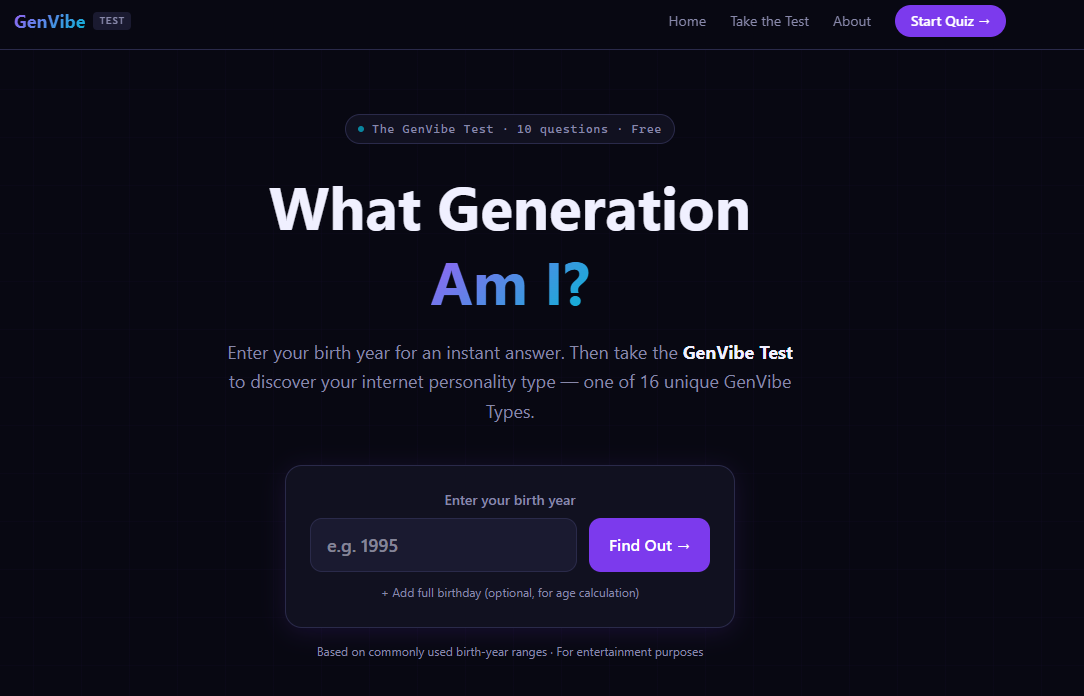
GenVibe Test is a small online tool built around the question:
“What generation am I?”
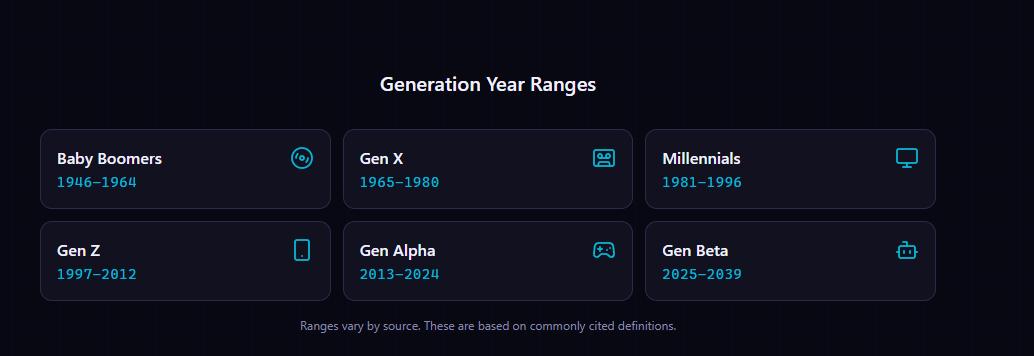
Users can enter their birth year and quickly see which generation they most likely belong to, such as:
- Baby Boomer
- Gen X
- Millennial
- Gen Z
- Gen Alpha
- Gen Beta
But the goal is not just to give users a label.
I wanted the tool to explain each generation in a more fun and cultural way — more like a generation vibe than a strict category.
For example, someone born in 2000 may technically fall into Gen Z, but they may still feel connected to some Millennial cultural memories. That is why I created dedicated pages such as:
- What generation am I if I was born in 2000?
- What generation am I if I was born in 2001?
- What generation am I if I was born in 1998?
These pages are designed to answer very specific birth-year questions instead of only giving a broad generation chart.
Why I Built This Tool
While researching generation-related searches and online discussions, I noticed that “What generation am I?” is a very common question.
This is especially true for people born near the boundary between two generations.
For example, someone might ask:
- What generation am I if I was born in 1979?
- What generation am I if I was born in 1980?
- What generation am I if I was born in 1984?
These years can be interesting because they sit near the cultural transition from Gen X to Millennials.
The same thing also happens for people born around the Gen Z and Gen Alpha boundary. For example:
- What generation am I if I was born in 2011?
- What generation am I if I was born in 2012?
- What generation am I if I was born in 2013?
- What generation am I if I was born in 2014?
These boundary years often create the most discussion and disagreement.
Some common cusp groups include:
- Xennials: between Gen X and Millennials
- Zillennials: between Millennials and Gen Z
- Zalpha: between Gen Z and Gen Alpha
So GenVibe Test is not trying to give an absolutely final or academic answer.
Instead, it helps people better understand where they may fit based on their birth year, generation range, and cultural context.
What Can GenVibe Test Do?
At the moment, GenVibe Test mainly supports:
- Entering a birth year
- Identifying the most likely generation
- Showing a short explanation of that generation
- Helping users understand differences between generations
- Creating more discussion around cusp years
It is useful for quickly answering questions like:
- What generation am I if I was born in 1998?
- What generation am I if I was born in 2000?
- What generation am I if I was born in 2001?
- What generation am I if I was born in 2011?
- What generation am I if I was born in 2012?
- What generation am I if I was born in 2013?
- What generation am I if I was born in 2014?
Instead of forcing users to read a long generation chart, each page focuses on one specific birth year and explains the likely generation in a more direct way.
It Is Not a Strict Academic Tool
It is important to note that GenVibe Test is not meant to be a strict academic source.
Different organizations, researchers, and communities may define generation ranges slightly differently.
For example, Gen Z is often defined as people born from 1997 to 2012, but some discussions may use slightly different boundary years.
That is why this tool is better understood as:
- a fun self-test
- a generation discovery tool
- a starting point for understanding generational differences
- a lightweight website for sharing and discussion
The goal is not to tell people that they must belong to one fixed generation.
The goal is to help them understand why they may be grouped into a certain generation and what that label means culturally.
This is also why pages like What generation am I if I was born in 2012? or What generation am I if I was born in 2013? can be useful. These years often sit close to the Gen Z / Gen Alpha discussion, so people may want a clearer explanation rather than just a simple label.
Why This Topic Is Worth Exploring
From the perspective of building small AI-assisted websites for global users, this kind of tool has several interesting advantages.
First, it is based on real search demand.
Many people search Google for questions like:
- what generation am i
- what generation am i if i was born in 2000
- what generation am i if i was born in 2013
- am i gen z or gen alpha
- generation calculator
- generation quiz
Second, it works well with long-tail SEO pages.
For example, each birth year can become a specific page:
- What generation am I if I was born in 1979?
- What generation am I if I was born in 1980?
- What generation am I if I was born in 1984?
- What generation am I if I was born in 1998?
- What generation am I if I was born in 2000?
- What generation am I if I was born in 2012?
- What generation am I if I was born in 2013?
- What generation am I if I was born in 2014?
These pages naturally match what people are searching for.
Third, the topic has social sharing potential.
Generation identity, age labels, cultural memory, and boundary-year debates are easy to discuss on platforms like Reddit, Facebook, blogs, and forums.
Why Birth-Year Pages Matter
One thing I found interesting is that many people do not search for a broad generation definition first.
Instead, they search with their own birth year.
For example:
- “What generation am I if I was born in 2000?”
- “What generation am I if I was born in 2012?”
- “What generation am I if I was born in 2013?”
This means a useful generation tool should not only have a homepage. It should also have detailed pages for specific birth years.
That is why GenVibe Test includes individual pages like:
- 1998 generation result
- 2000 generation result
- 2001 generation result
- 2011 generation result
- 2012 generation result
- 2013 generation result
- 2014 generation result
These pages make the experience more specific and also help the site cover more real search questions.
Future Plans
There are several directions I may continue to improve.
1. Add More Detailed Cusp Generation Explanations
- Xennials
- Zillennials
- Zalpha
2. Create More Individual SEO Pages for Different Birth Years
Some existing examples include:
- What generation am I if I was born in 1979?
- What generation am I if I was born in 1980?
- What generation am I if I was born in 1984?
- What generation am I if I was born in 1998?
- What generation am I if I was born in 2000?
- What generation am I if I was born in 2012?
- What generation am I if I was born in 2013?
3. Improve Share Cards
- Let users generate a visual generation result card
- Make sharing work better on mobile
- Make the result easier to share on social platforms
4. Add More FAQ Content
- What generation is 2000?
- Is 2012 Gen Z or Gen Alpha?
- What is a Zillennial?
- What is Zalpha?
- Are generation ranges always the same?
5. Collect Real User Feedback
- Blog comment sections
- Generationology communities
Final Thoughts
GenVibe Test is a small tool, but it represents a practical website-building idea:
Start from a real search question, build a lightweight tool, then improve it through SEO pages, sharing features, and community feedback.
It does not need to be a complicated product from the beginning.
The core is to answer one clear question:
What generation am I?
From there, the tool can slowly grow through content, search traffic, social sharing, birth-year pages, and real user discussions.
Website:
https://genvibetest.com/